Freelancing on a B permit.
EU/EFTA citizens may freelance on a B permit from day one and prove it at renewal; third-country nationals need cantonal approval unless they came as family members. The set-up — Ausgleichskasse, ordinary tax return, three insurances, pillar 3a — and a check for your case.
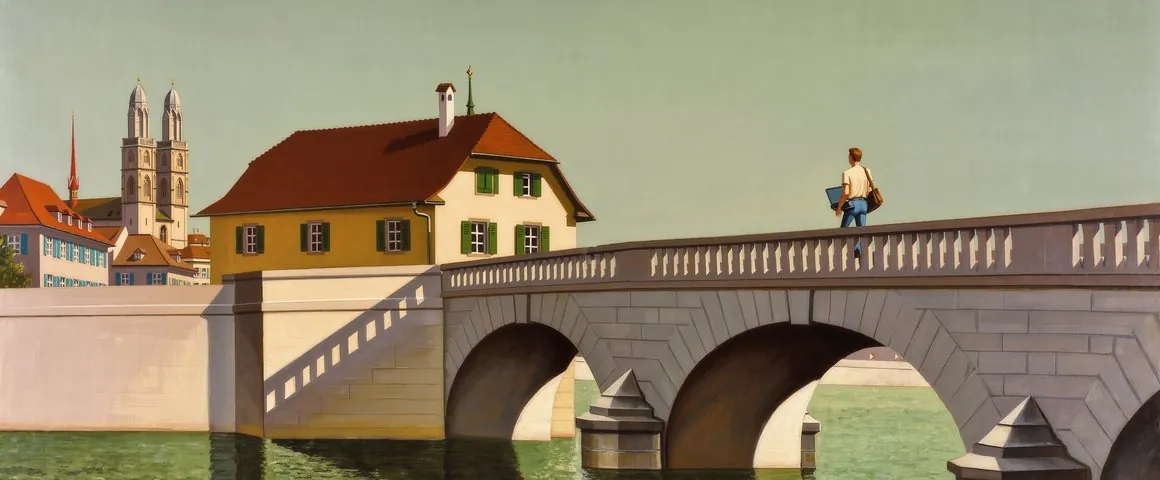
An EU/EFTA citizen may freelance on a B permit from day one. Anyone else needs the canton’s yes — unless they came as a family member.
Free movement includes working for yourself, so an EU/EFTA B permit is no obstacle to freelancing: you register, you get recognised by the AHV, and at renewal you show that the business pays your bills. For third-country nationals the permit is tied to the job it was issued for, and self-employment is a separate cantonal decision. Below: the three paths, the set-up that is the same for all, and a check for your case.
Five years, zero percent, 36 288.
Permit and expected income.
Six things every B-permit freelancer does once.
- The Ausgleichskasse letter is your key documentRegister with three invoices; the recognition letter proves self-employment to the migration office, to clients and to the tax office. Contributions: 10 % of net income, sliding scale below CHF 60 500, minimum CHF 530, billed quarterly. [5]
- Taxes: a return, not tax at sourceSelf-employed income is never taxed at source. A B-permit freelancer files an ordinary tax return — with the self-employment sheet — and deducts business costs, AHV and pillar 3a like any Swiss freelancer. Employed income beside it is taxed at source and credited. [6]
- Insurance: three gaps to close yourselfNo unemployment insurance exists for you. Accidents: voluntary Suva/UVG or at least accident cover in your health insurance. Liability: business liability insurance before the first client. Pension: pillar 3a up to CHF 36 288. [7]
- Renewal: show that it worksAt each permit renewal the migration office checks that your self-employment secures your living: AHV statements, accounts, invoices. Reliance on social assistance can cost the permit. Keep the folder tidy from day one. [1]
- C permit laterAfter five years (EU/EFTA and some other states) or ten years, with good integration and language, the settlement permit removes every remaining restriction — including the renewal checks. [10]
The seven steps in full: Becoming self-employed in 7 steps. The Ausgleichskasse: Registering with the Ausgleichskasse. Invoices and VAT: Freelancing basics: invoices, VAT, bookkeeping. Every permit letter: Permits B, C, L, G: who may work on the side.
Short answers.
Can I freelance on a B permit in Switzerland?
EU/EFTA citizens: yes, free movement covers self-employment; prove it at renewal with AHV recognition, invoices and accounts. Third-country nationals with an employer-based B permit: only with cantonal approval under AIG Art. 19. Third-country spouses of Swiss or C-permit holders: yes, without approval.
Do I still pay tax at source as a freelancer?
Not on self-employed income — it is never taxed at source. You file an ordinary tax return with the self-employment sheet. If you also have a salary, that part stays at source and is credited.
What must I register?
Your commune within 14 days (EU/EFTA self-employed), the cantonal Ausgleichskasse as self-employed above CHF 2 500 a year, VAT only from CHF 100 000 turnover, the commercial register only from CHF 100 000 (voluntary below — useful evidence).
Which insurances do I need as a freelancer on a B permit?
Health insurance continues as before; add accident cover or voluntary Suva insurance; take business liability insurance; save in pillar 3a (up to CHF 36 288). There is no unemployment insurance for the self-employed.
Can my self-employment be a reason to lose the permit?
Only if it does not secure your living and you rely on social assistance. A profitable freelance business with proper records is exactly what the renewal asks for.

Every task. One app.
Werkara connects people who need help around the house with verified taskers nearby. Register in a few minutes and get your first task this week.
Become a taskerWhere the rules come from.
- [1]Canton of Zürich, migration office — Directive on the Free Movement Agreement (1 May 2026) — EU/EFTA self-employed: five-year B permit on proof of self-employment (AHV recognition, invoices, accounts); activity must secure a living; checked at renewal. www.zh.ch
- [2]State Secretariat for Migration (SEM) — Weisungen AIG, chapter 4, section 4.7.2 — self-employment of third-country nationals: cantonal approval, economic interest, financial means. www.sem.admin.ch
- [3]Swiss Confederation — AIG, Art. 19 (self-employment, third countries), Art. 38 (change of activity), Art. 46 (family members may work employed or self-employed). www.fedlex.admin.ch
- [4]ch.ch — the Swiss authorities online — Working in Switzerland as a foreign national — self-employed EU/EFTA register within 14 days. www.ch.ch
- [5]AHV/IV information centre — Merkblatt 2.02 — self-employed contributions 2026: 10 %, sliding scale, minimum CHF 530; recognition letter. www.ahv-iv.ch
- [6]Federal Tax Administration (ESTV) — Besteuerung an der Quelle — self-employed income is not taxed at source; ordinary assessment applies. www.estv2.admin.ch
- [7]UBS — Pillar 3a maximum 2026 — CHF 7 258 with a pension fund; 20 % of net income up to CHF 36 288 without. www.ubs.com
- [8]Federal Tax Administration (ESTV) — MWST-Steuerpflicht — VAT from CHF 100 000 turnover. www.estv.admin.ch
- [9]EasyGov — EasyGov.swiss — online registrations for new businesses. www.easygov.swiss
- [10]State Secretariat for Migration (SEM) — Settlement permit C — after five years (EU/EFTA and some states) or ten years, with integration. www.sem.admin.ch